
RESPONSE OF THE IONOSPHERE TO SOLAR FLARES: A MULTI-INSTRUMENT ANALYSIS
DOI:
https://doi.org/10.71465/jgs3Keywords:
Solar flares, Ionospheric response, TEC variability, Multi-instrument observationsAbstract
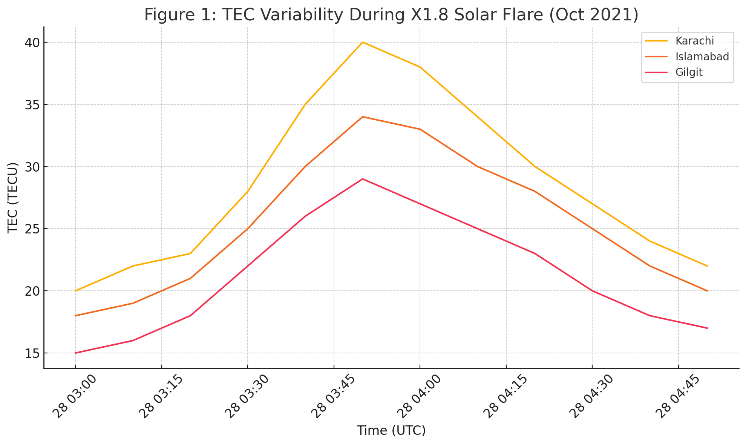
Solar flares are one of the most intense drivers of ionospheric disturbances due to the sudden increase in extreme ultraviolet (EUV) and X-ray radiation. This study presents a comprehensive multi-instrument analysis of ionospheric responses to solar flare events observed between 2010 and 2023 over Pakistan. Using data from GNSS receivers, ionosondes, and the Atmospheric Imaging Assembly (AIA) onboard SDO, we quantify variations in the ionospheric Total Electron Content (TEC), critical frequency (foF2), and GPS signal disruptions. Results reveal a rapid ionospheric response within 5–10 minutes of flare onset, with peak enhancements during X-class events. Comparisons between low-latitude (Karachi) and mid-latitude (Gilgit) sites indicate latitudinal dependence in response amplitude and duration. This study highlights the importance of integrating space-based and ground-based systems for real-time space weather monitoring and forecasting.
References
Ahmed, S., & Sohail, N. (n.d.). *Sustainable global supply chain: A systematic literature review* [Unpublished manuscript]. Institute of Business Administration Karachi and International Islamic University Malaysia.
Downloads
Published
Issue
Section
License
Copyright (c) 2021 Dr. Ahsan Raza (Author)

This work is licensed under a Creative Commons Attribution 4.0 International License.
All articles published in the Journal of Geospace Science (JOGSS) are licensed under the Creative Commons Attribution 4.0 International License (CC BY 4.0). This license allows others to share, copy, distribute, and adapt the work, provided proper attribution is given to the original author(s) and source.